.png)
The Distance Between a Right and a Ration
Updated: Aug 1
Three months in Gurugram's migrant settlements, where dignity arrives one document, one classroom, one hospital bed at a time
Every day, migrant families face barriers that are often invisible - a missing document, an unlinked ration card, an incomplete application, or simply a lack of information. These small barriers can prevent a family from accessing food, healthcare, education or housing.
Supporting migrant families to overcome these barriers has always been at the heart of Agrasar's work. This quarter brought new examples of what becomes possible when the right support reaches people at the right time.
Yogesh Bangal's story is one example.
It is a May morning in Sikanderpur, and Yogesh Bangal is standing in a queue that does not exist
Twelve Years of Barriers
For twelve years, the Fair Price Shop nearest his rented room refused to recognise his family's ration card, which had been issued in a village in Uttarakhand before he migrated to Gurugram in 2014. The shopkeeper would shrug. The system would not recognise his card. Like many migrant workers, Yogesh would lose half a day's wages every time he tried to access his entitlement. Eventually, his family stopped trying. Ratio had to be bought from the open market, often at nearly two-four times the subsidised price, whenever they could afford it.
June Morning Is Different
June morning is different. His One Nation One Ration Card (ONORC) details were migrated and verified in June after an Agrasar Saathi - a neighbour trained as a community navigator - supported him through two visits to the Fair Price Shop and a follow-up with the district office. Today, there is no queue for him. The shopkeeper checks the machine, his thumb print is authenticated, and twenty kilograms of subsidised grain are issued to his family.
The transaction takes four minutes. The journey to it took twelve years.
Yogesh's story reflects what changed this quarter. Across Gurugram, Agrasar helped migrant families complete essential documents, access government schemes, enrol children in school, receive healthcare and secure housing. Every small step brought a family closer to safety, dignity and opportunity.
Subsidised rations reach families at the Sikanderpur Centre - the last step in a journey that began with a single verified document.
Quarter at a Glance
Between April and June 2026, Agrasar continued to strengthen access to Social Security and Education for migrant workers and their families in Gurugram.
Social Security Programme
Through our Social Security Programme, we reached 1,726 people through community awareness and outreach, facilitated 958 government scheme linkages, and helped families complete 240 essential identity documents, including Aadhaar, Family IDs and ration cards. During the quarter, 152 families accessed Ayushman Bharat, 34 families benefited from food security support through the One Nation One Ration Card (ONORC) initiative and 25 girl children were enrolled in the Sukanya Samridhi Yojana, helping secure their financial future
Education Programme
Through our Education Programme, 20 children attended our Community Learning Centre, including 8 new enrolments, while 3 children were successfully mainstreamed into government schools. As government schools remained closed for the summer vacation, no school-based sessions were conducted during the quarter.
₹6,66,825
Direct Government Benefits
This quarter, our work enabled families to receive ₹6,66,825 in direct government benefits
₹17,56,500 Approved Entitlements
Unlocked an additional ₹17,56,500 in approved government entitlements that are expected to reach families in the coming months
₹7.5Cr Financial Protection
Secured ₹7.5 crore worth of financial protection through the Ayushman Bharat Scheme
Our Impact Since 2021
Since 2021, Agrasar has reached 64,393 migrant workers and families, facilitated 32,966 government scheme linkages, supported the completion of 12,683 identity documents, enabled to receive ₹6,38,75,498 in direct government benefits, and secured approximately ₹200 crore worth of protection through Ayushman Bharat and PM Suraksha Bima Yojna for around 4,000 families.
64,393
Migrant Workers & Families Reached
32,966
Government Scheme Linkages
12,683
Identity Documents Completed
₹6.38Cr
Direct Government Benefits
₹200Cr
Protection Secured
Through Ayushman Bharat and PM Suraksha Bima Yojna for around 4,000 families
Through our community Worker Facilitation Centres, 173 trained Community Saathis, and strong partnerships with government departments, we continue to help migrant families turn their rights into real opportunities for security, dignity and a better future.
Centre Highlights
While the numbers show the scale of the work, each Worker Facilitation Centre responded to the different needs of its community. Here's what changed across our three centres this quarter.
Gandhinagar Centre
Expanding access for formal-sector workers
This quarter, Gandhinagar Centre strengthened its engagement with formal-sector workers by taking services directly to factories and expanding outreach into nearby worker settlements. The introduction of Third-Sunday centre openings also enabled around 100 workers to access support on their weekly day off.
Labour Welfare Fund Campaign
The Labour Welfare Fund (LWF) campaign was the centre's biggest achievement. Many factory workers learned for the first time that they were eligible for benefits under the scheme despite contributing to it for years. As a result, 135 workers registered, 197 applications were submitted, ₹157,500 reached beneficiary accounts, and approximately ₹15 lakh in approved education and welfare benefits is expected to reach eligible families in the coming months.
Health & Housing
The centre also organised an Ayushman Bharat drive, supporting 53 families with health coverage worth ₹2.65 crore. This quarter, two beneficiaries from the Gandhi Nagar community received cashless treatment under the Ayushman Bharat scheme, with healthcare support worth ₹2,21,000.
Also three families received permanent home keys under the Chief Minister Awas Yojana.
Additionally, the centre conducted eight community awareness sessions, reaching 238 community members with information on various social security schemes, rights, and entitlements.

Third-Sunday opening at the Gandhinagar Center (21 June): formal-sector workers use their only day off to learn about the Labour Welfare Fund and government insurance schemes.

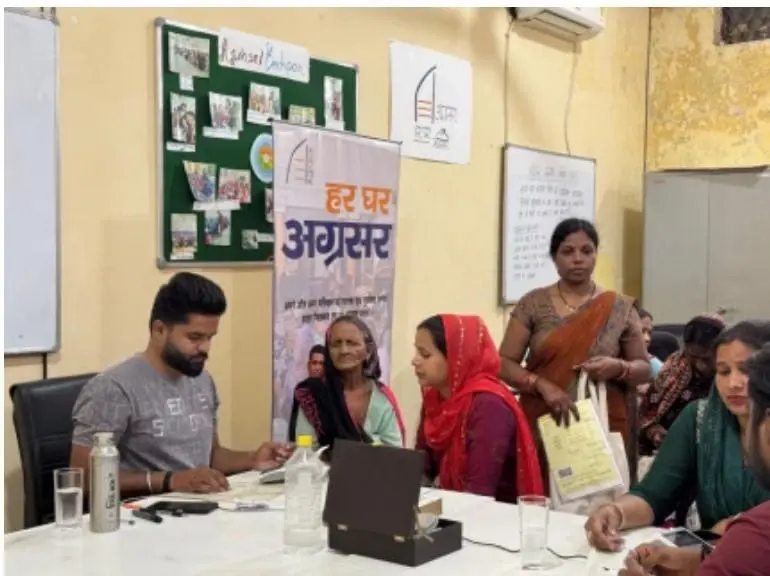
Women of the community at a Har Ghar Agrasar awareness session on the Social Security Schemes
Devilal Colony Centre
Supporting School Admissions and Community Learning
This quarter, Devilal Colony focused on helping children enrol in school while strengthening engagement with parents. Twenty children attended the Community Learning Centre, including eight new enrolments, and three children were successfully mainstreamed into government schools. Weekly bridge-learning and music sessions helped children stay engaged, while regular parent meetings encouraged families to actively support their children's education During the school admission process, the team found that nearly 70% of out-of-school children were unable to enrol because they lacked one or more essential documents, such as Aadhaar, Family ID or birth certificates. This reinforced that documentation remains one of the biggest barriers to education for migrant families. In response, the centre intensified support for document completion, school admissions and government scheme awareness.
Documents & Scheme Linkages
During the quarter, the centre facilitated 71 identity documents, 210+ government scheme linkages, and conducted six community awareness sessions with 190 participants, helping families access education and social security entitlements.
Health & Housing
The Devilal Centre also organised a preventive health camp in partnership with the Tanisa Foundation and the Rajiv Gandhi Cancer Institute & Research Centre. A total of 56 community members received health screenings, and one woman was referred for follow-up treatment.
Alongside its education work, the team organised Labour Welfare Fund awareness camps in garment factories, continued Aadhaar, banking and health support through community camps, expanded outreach to Ravinagar and Krishna Colony, and supported two families in receiving permanent homes under the Chief Minister Awas Yojana.

Learning beyond the blackboard: an audio-visual session at the Learning Centre keeps children engaged as they progress through bridge courses.
Sikanderpur Centre
Bringing health and social security closer to the community
This quarter, Sikanderpur focused on improving access to healthcare, food security and essential government services for migrant families. The centre organised a preventive health camp in partnership with Tanisa Foundation and the Rajiv Gandhi Cancer Institute & Research Centre, where 54 community members received health screenings and 4 individuals were linked to follow-up treatment. During the summer heatwave, a community ration camp ensured that 167 families could access subsidised food closer to home, reducing travel, waiting time and loss of daily wages.
Alongside these initiatives, the centre continued regular awareness sessions, government scheme facilitation and documentation support, while organising outreach at the Sikanderpur labour chowk and community workshops on health, hygiene and gender. During the quarter, the centre facilitated 300+ government scheme linkages, supported 90+ identity documents, and conducted 8 community awareness sessions with 386 people on various social security schemes, rights & entitlements and preventive health. The centre further supported 28 families in receiving permanent homes under the Chief Minister Awas Yojana

The preventive health camp at Sikanderpur, in partnership with Tanisa Foundation and Rajiv Gandhi Cancer Institute & Research Centre — 54 community members screened, 4 moved into follow-up care.

A health-and-hygiene workshop for women: cervical cancer awareness delivered in the community's own space, in its own language.
Agrasar's Support and the Ayushman Card Gave a Family a New Lease on Life
Beneficiary
Mr. Bhim Chaudhary, Mrs. Renu Devi and Family
Location
Shakti Park, Gurugram
Native Place
Supaul, Bihar
Agrasar's Timely Support
With Agrasar's guidance, the family's eligibility under the Ayushman Bharat – PM-JAY scheme was verified and all documentation was completed on the same day. They received their Ayushman Card the very next day, enabling timely access to treatment.
Medical Support Received
Prostate Surgery (10 Mar 2026, Cashless) · Heart Surgery (12 May 2026, Cashless) · Estimated Savings: ₹2,50,000
Family Background
Mr. Bhim Chaudhary originally belongs to Supaul district in Bihar. For the past 14 years, he has been living with his family in a rented house in Shakti Park, Gurugram. His family consists of his wife, Mrs. Renu Devi, one son, and one daughter. Their daughter was married around one and a half years ago.
Mr. Chaudhary previously worked as a street vendor, while Mrs. Renu Devi was employed in an export company. The family spent nearly ₹7 lakh on their daughter's wedding, exhausting all their savings and forcing them to borrow money to meet the expenses.
The Beginning of the Crisis
At the beginning of 2026, Mr. Chaudhary's health began to deteriorate. He experienced severe difficulty in urination and initially sought treatment from a private doctor in Gurugram, spending approximately ₹25,000–₹30,000. Despite the expenses, his condition did not improve and continued to worsen.
In early March 2026, he was admitted to Vivekananda Hospital, where doctors diagnosed an enlarged prostate that required immediate surgery. He remained in the ICU for nearly six days, and medical expenses continued to increase due to medicines, hospital charges, and other treatment costs.
The family had already exhausted its savings because of the wedding and had an outstanding loan. To meet the treatment expenses, they had to borrow an additional ₹1.5 lakh from relatives.
During this time, the hospital informed them that an Ayushman Bharat Card was required for cashless surgery. However, the family neither possessed the card nor knew how to obtain it. Doctors explained that without the card, they would have to spend an additional ₹40,000–₹50,000 on the surgery. As Mr. Chaudhary was unable to work due to his illness, the family's income almost came to a standstill, leaving them under severe financial, emotional, and social stress.
Agrasar's Intervention
While Mr. Chaudhary was in the hospital, one of Mrs. Renu Devi's friends from Shakti Park told her about Agrasar. She immediately visited Agrasar's Gandhinagar Community Facilitation Centre and explained the family's situation.
The Agrasar team promptly verified the family's eligibility under the Ayushman Bharat scheme and confirmed that they qualified. The required documentation was completed on the same day, and the family received their Ayushman Card the very next day.
This swift support ensured that there was no delay in beginning the treatment.
First Surgery: Successful Prostate Operation
On 10 March 2026, Mr. Chaudhary underwent a successful prostate surgery at Vivekananda Hospital. The entire treatment cost was covered under the Ayushman Bharat scheme.
Receiving the Ayushman Card on time removed the family's financial worries and allowed treatment to begin immediately, providing significant financial relief.
Second Challenge: Heart Surgery
Following the prostate surgery, further medical examinations revealed that Mr. Chaudhary also had a serious heart condition requiring surgery.
On 12 May 2026, he was admitted to Silver Streak Multi Speciality Hospital. The estimated treatment cost was around ₹1,78,000, which the family could not afford.
Fortunately, the Ayushman Card obtained earlier once again became a lifeline. The heart surgery and hospitalisation were fully covered under the scheme through cashless treatment. After a successful operation and four days of hospitalisation, Mr. Chaudhary was discharged. The family now only spends around ₹6,000 per month on postoperative medicines.
Current Situation Today, Mr. Bhim Chaudhary's health has improved considerably, and he is gradually returning to a normal life.
However, the family continues to face financial hardship. Mrs. Renu Devi, who previously earned around ₹11,000 per month in an export company, resigned in February 2026 to care for her husband.
Currently, the family's primary source of income is their son, who has completed Class 12 and runs a small juice cart. The debts incurred for their daughter's wedding and Mr. Chaudhary's treatment continue to burden the family. Relatives who lent them money are now demanding repayment and are even asking the family to transfer their land in return.
Once again, Agrasar continues to stand by the family. The team is currently helping Mrs. Renu Devi withdraw her Provident Fund (PF) savings so that they can repay part of their debts and improve their financial stability
Beneficiary Testimonial
Mr. Bhim Chaudhary
"When my health kept deteriorating and the doctors advised surgery, our family was going through an extremely difficult time. We simply could not afford the treatment. Agrasar became a ray of hope for us. Because of their support, I received my Ayushman Card on time, and both my surgeries became possible. Without this timely assistance, we could never have afforded such expensive treatment. Today, I am on the road to recovery, and I sincerely thank Agrasar and the Ayushman Bharat scheme."
Mrs. Renu Devi
"Before approaching Agrasar, we had already spent nearly ₹1.5 lakh on my husband's treatment and were buried in debt. The doctors told us that he would need two surgeries costing around ₹2.5 lakh, which was impossible for us to arrange. They suggested getting an Ayushman Card quickly for free treatment, but we had no idea how we could obtain one so fast.
The Agrasar team completed the entire process and helped us receive the Ayushman Card within just two days. It felt like a miracle. Because of that card, both surgeries were completed without any major financial burden. Otherwise, we would have had to pay around ₹2.5 lakh ourselves and might even have been forced to sell our land—the family's most valuable asset. Today, my husband is healthy and with us. I sincerely thank Agrasar and the entire team for their invaluable support."
Mr. Bhim Chaudhary's story demonstrates how timely information, proper guidance, and access to government welfare schemes can transform the lives of vulnerable families. Agrasar identified the family's eligibility, completed the necessary documentation within a day, and ensured that the Ayushman Card was issued the very next day, allowing life-saving treatment without delay.
Behind every working ration card, every child who returns to school, and every family that accesses healthcare or a permanent home is the same principle: rights create impact only when people can actually access them.
Continuing Our Mission, Together
This quarter reminded us that lasting change is built through collaboration. Every family that accessed healthcare, every child who returned to school, and every government entitlement that reached the right person was made possible by the collective efforts of our team, Community Saathis, partners, government departments, supporters and well-wishers.
Thank you for being part of this journey. We look forward to sharing more stories of change as we continue working to ensure that every migrant family can access the rights, opportunities and dignity they deserve.